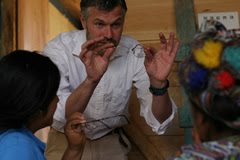
Showing posts with label Greg van Kirk. Show all posts

Thursday, July 1, 2010

Standing on the Shoulders of Giants: Leadership, Learning and the Millennial Generation


It was Isaac Newton who said, “If I have seen further, it is by standing on the shoulders of giants”. This article concludes an interview with Greg Van Kirk, a giant in the field of social entrepreneurship and a leader who has contributed immensely to our vision of community development.

Two previous segments of the interview with Greg have run on this blog space, and first time readers are encouraged to read these in order to get the full grasp of Greg’s work and to also watch the brief video that puts a face to the efforts.

If we, as The Acacia Group build something new or orient our approach to international community development in a slightly different way it is because of people like Greg and organizations like Social Entrepreneur Corps who have gone out and charted a course on what successful community programs can look like; programs that are sustainable, and that are locally run and operated.

Greg’s work is also informed by input and leadership by engaged student interns, who in turn benefit from those who have gone before. I asked him about working with this group of learners and contributors.

Greg, in a simplistic way – that is in many ways too limiting, the millennial generation has been described as fitting in between two poles. One, they are quite entitled, they want what they want and when they want it and; two, they are very plugged in to the issues around globalization and the need for full engagement in social responsibility to help others and the planet. What have you observed as you watch these young people engage?

While the bulk of the students who show up would naturally fall into the latter group of seeking to help, there are still vestiges of the former group too, who just want things to go easy. This falls away fairly quickly. The experience of working with local villagers is enhanced for participants who go in with an open hand, and open mind and are prepared to get their hands dirty. Sitting on the sidelines is not an option and the act of “doing” erodes the sense of entitlement very quickly. During the volcano in June, while it did not directly impact our program, it did have an effect on communities close by – we had a team meeting and the response was unequivocal “We are fine, this event has happened to us, now let’s get out there and go help”. These guys are inspirational, they did this independent of direction from our program. These are the leaders of tomorrow who are showing their skills right now.

From a corporate social responsibility perspective (CSR) - it is really quite fascinating. Established leaders in business or the social arena may do “battle” as to the appropriateness of interactions and the place on the continuum of certain efforts. Young leaders see no such dichotomy – there is no best approach – they simply live the concept of do well by doing good. Social is not a bad word, business is not either.

Voluntourism is growing and becoming more popular. Critics are concerned about what can be a transactional and surface level approach to change. What are your thoughts on this?
If it is about sampling of a culture then I would argue that it is not effective for either the participant or the local villager. If it is about true learning and making a true impact then that is another. It should always be about supporting the end needs of the beneficiaries and supporting those organizations that support the beneficiaries. (We had previously established that Greg and SEC are a development organization versus a volunteer organization) One of things we have to guard against is students saying “I will help in this way” i.e. their way. Instead they should be asking “What do you want” – often this is not sexy stuff, but it can create a huge impact.

What does the future hold for Greg Van Kirk?

The connection to Ashoka and the Ashoka Lemolson Fellowship has been huge. While we have been encouraged to develop our model of microconsignment elsewhere, to be done well it takes a lot of time. You have to create a relationship of trust and integrity. This cannot be transactional and quick. The Fellowship has opened lots of doors to share information with brilliant leaders in the field, and as a result we can share and combine ideas that can have an impact in different places. We don’t always have to use any one program but can constantly adapt and learn based on the application and location.
The truth of the matter is that our model and other Ashoka programs work and can work all over the world. We have an obligation to make this happen. So we work with our own internal leadership team and try to find ways to create replication, working with good partners elsewhere to leverage their connections into an area.
We are also working with the Eugene Lang Entrepreneurship Centre at Columbia University where we are focused on the creation of centre of excellence for studying and improving microconsignment – we can create obsolescence for ourselves by housing the knowledge at an accessible connection point.

Thoughts on engaging leaders…?

We have unintentionally created a culture of effective leadership – we attract people who are drawn into a certain way of being – we help them shape their thinking, you know, fundamentals – begin with the end in mind – provide servant leadership –don’t manage, don’t tell – learn to trust. Trust your team implicitly- have total faith that even when they make mistakes they are just learning and that they will be fine.

The generosity and openness of Greg’s vision is truly remarkable and allows for a cocreation of programs and services that can have a profound effect on the lives of all who participate. Many thanks go to him for giving us the time for this conversation, for the partnership and for allowing us to stand on his shoulders.

The Acacia Group’s mission is to offer transformative and unique leadership development for organizations and individuals seeking to live out their global citizenship. To do this we blend knowledge from Corporate Social Responsibility, Community Development and Leadership Development and Learning to emerge new opportunities for excellence for our clients.

Greg Van Kirk and SEC has generously agreed to a partnership with The Acacia Group in the development of effective leadership through work in Guatemala. We are currently offering a unique opportunity for a smaller group to join us in late November 2010 and to learn and help shape our progam. Contact us for more information or to join our upcoming webinar on July 7th at 12:00 noon PDT.

Thursday, June 24, 2010

Smart Business - “Baskets of Solutions” and the Millennium Development Goals

This blog is the second in a series that captures a conversation I had with Greg Van Kirk, Ashoka-Lemolson Fellow and author of “The Microconsignment Model – Bridging the “Last Mile” of Access to Products and Services for the Rural Poor. You are encouraged to click the previous hyperlink to get a sense of the profound difference Greg makes in his work. As a teaser, consider the following excerpt that begins to portray the value of the MicroConsignment model.

Until recently, Carolina Amesquita, the principal at La Escuela Ramona Jil primary school in Chimeltenango, Guatemala lamented daily the her students were drinking contaminated water directly from the tap, often contracting gastrointestinal illnesses that kept them out of school. Others in the community were suffering too. Juana Ramirez, an expert weaver in the village of San Mateo, could no longer see well enough to sort her threads by color. Her productivity had plummeted, further stressing her already struggling family. While preparing meals over an open-pit fire in her home, as Guatemalan women had done for generations, Alva Rios was inhaling harmful smoke for hours each day. Julia Garcia was spending more and more of her family income on electricity bills, while Benito Ramirez had no electricity in his home and at night had to study by candlelight.

These and similar problems confronting thousands of rural Guatemalans have now been solved through the hard work of two Guatemalan women. Yoly Acajabon and Clara Luz de Montezuma, local homemakers in their mid-40’s, started their own enterprises in 2004 with no entrepreneurial experience of start-up capital. Working within the MicroConsignment Model (MCM), these extraordinary women are providing low –income villagers with essential products and services that help improve their health, nutrition and economic situations – and they are earning incomes for their own families while they doing so.


La Escuela Ramona now owns a water-purification device. Juan Ramirez got a free eye-exam and bought low-cost reading glasses. Alva Rios now cooks on fuel-efficient stove with a chimney. Julia Garcia has installed energy-efficient light bulbs in her home, and Benito Ramirez owns a solar panel and LED light that brightens and entire room.

By providing access to needed but previously unavailable products, Yoly and Clara are “bridging the last mile” in the supply chain of products needed by the rural poor in an appropriate and sustainable way. In the beginning they simply sold reading glasses, but over time their “basket of solutions” has become a growing enterprise…….

With support from university students, recent graduates and a permanent field staff, Social Entrepreneur Corps ( SEC) provides training in business skills, access to products and seed funding. To date they have provided training to over 200 women entrepreneurs and broker organizations such as community libraries who can also then provide business support and skills to the ranks of entrepreneurs.

DH - Greg, you have indicated that you don’t see yourself as a volunteer program per se, but as a development program.

GVK – That’s right. We see our role as creating something that is sustainable, that creates a scenario whereby if Social Entrepreneur Corps were to disappear overnight that the program could still run. Skills and resources are created that we contribute to but we don’t own them. They would still survive. It is just smart business to create sustainable infrastructure – to create strong development work.

DH – I know we are all guarding against the creation of dependency and a neo-colonial approach to development, how do you avoid this?

GVK - We work best when we all work together – we bring strengths and weaknesses, and we are constantly curious about our role and we interact with beneficiaries. Ultimately we will leave when we don’t add value anymore. We want to create self-sustainability, we are constantly looking at driving costs out of the equation, but having said that we need to do everything from development to departure at the right pace, a timing agenda creates an urgency and – velocity of our interaction should introduced as a factor. We build trust – this takes time, but creates a sense of cooperation and achievement. If we insist on a transactional relationship only, then there will be no trust and true sustainability becomes elusive if not impossible.

The final section of the interview will run next week and Greg will discuss how young learners experience the program as interns, and what the future holds for him and this model.

As the subtitle of this blog indicates, there is a real connection to Greg’s work, the work of Yoly and Clara and the Millennium Development Goals. This week and next the G8 and G20 will meet in Ontario, Canada to discuss their way in the world and featured on the agenda are the Millennium Development Goals (MDG). While leaders and bureaucrats pontificate and navel gaze about actions to support already agreed upon commitments, now and again in September in New York, Greg, his team of interns and Yoly and Clara using their “basket of solutions” are already taking a bite out the MDG. Moving to eliminate poverty, creating a better, cleaner and sustainable environment, achieving primary universal education, and promoting gender equality and empowering women are tangible products of the work being done in Guatemala. One can assume that success in these goals will also impact the remaining goals through true systemic shifts. It is curious to note that this is not being done via aid or hand outs but rather smart and effective business leadership built upon the back bone of trust, leading to sustainability.

The Acacia Group is proud to be working with Greg and Social Entrepreneur Corps in Nebaj, and is offering an opportunity for individuals or groups to participate in, observe and learn from SEC and the citizens of Nebaj. This experience is combined with personal and group leadership development coaching before, during and after the trip for up to three months. Interest is building, so book soon at www.theacaciagroup.ca or join us on one of our upcoming webinars to get more information.

Sunday, June 20, 2010

Social Entrepreneurship and Leadership by Example in Guatemala- Part I


Earlier this week I had the good fortune to meet again with Greg Van Kirk, Ashoka Lemolson Fellow, and Social Entrepreneur in Residence at Columbia University. Greg is an open, engaging and skilled social entrepreneur who has demonstrated that with passion, intelligence and integrity – communities can be made stronger.

The discussion was rich with information and as a result, over the next week or so this blogspace will contain excerpts from that conversation. Further information on Greg’s work can also be found at http://www.newdevelopmentsolutions.com/ . His worked is also featured in the video found on this site.

Some brief background first: Greg runs a variety of programs- including Social Entrepreneur Corps, (SEC). This program provides development programs in Ecuador, Guatemala, and Nicaragua. Working with local agencies, interested local entrepreneurs and with input from seventy-five university students and recent graduates interns from the US – Greg has supported the development of a variety of programs that benefit local villagers in these three countries.

Can you describe your program?

Well we looked at the various programs that existed such as academic programs that focused on the learner’s academic needs, or even volunteer programs that tend to be more relief focus and realized that that would not work for our vision. We don’t see our program as a volunteering program, we are a development organization that focuses year round on developing local people. We have been able to create a structure whereby people can, on a short term basis – focusing as apprentices or interns – share their skills in a manner that adds capacity to the local community; the focus is always on the beneficiaries and the work flows from there. 80% of our current permanent workforce are former interns of the Social Entrepreneur Corps.

I know that you started with the Centro Exlprativo, can you tell me more about that and how that has evolved and benefitted from some of the “incubator” work of SEC?

Centro Explorativo, in Nebaj is an education centre that started as a literacy program, but now has over 2000 books, free computer classes, after school classes on math and literacy, along with sports programs – all these services are free up and running since 2003. The program now boasts three teachers, and is owned and administered by a local organization of Guatemalan’s and has had thousands of participants.

I know that a logical spin-off was combining the computer skills with supporting the needs of tourists via an internet café?

That’s right, from education there has also been a focus on tourism- a site that started as a restaurant, has evolved and created spin- offs such as a guiding business, a coffee shop, a hostel, internet centre, language school – that have now be owned by local folks since 2004. SEC provided $25,000 of program support resulting in total revenues of $750,000.

These are concrete examples of creating a tangible presence in the community, but these locations are backed up the creation of skills that are portable. SEC is a driver of the micro-consignment model . The purpose of which is to create access to products and services that ordinarily would not exist or are donated. We stared with the distribution of wood burning stoves, and now distribute eye glasses, energy efficient bulbs, lamps, and now water treatment programs. These are just the products but SEC has trained and supported – over 200 women entrepreneurs and also work with broker community organizations like libraries, who can in turn provide training. We help create village campaigns, where we assist entrepreneurs do the marketing, advertising etc to a village, building anticipation and then they show up with their goods – so far we have executed over 2000 of these campaigns, sold over 60,000 products. Earned net income in aggregate around $75,000. Now, a social enterprise has been created to allow this activity to continue and to be sustained– it is share based company model owned by Guatemalan men and women, homemakers with no experience, now own a company that generates $80,000 annually in revenue. We estimate that the economic productivity benefit from this i.e. health issues with a stove, savings from not having to buy water or consume contaminated water, increased productivity due to being able to see because of glasses is around $1.4 million in Guatemala alone. We have now taken this model to Ecudaor and Nicargaua – and all sales are even across the board and consistent with the beta work we have done in Guatemala

Greg’s work has captured the attention of the social entrepreneur community and there is a desire to determine how this can be duplicated in other sites. More information on this issue, and the notion of engagement will be discussed in blogs posted later this week. Stay tuned, or subscribe!

The Acacia Group works with Greg and Social Entrepreneur Corps in Nebaj, and is offering an opportunity for individuals or groups to participate in, observe and learn from SEC and the citizens of Nebaj. This experience is combined with personal and group leadership development coaching before, during and after the trip for up to three months. Interest is building, so book soon at www.theacaciagroup.ca

Wednesday, March 31, 2010

Making a Difference in Nebaj - Guatemala

Check out the video that shows the work currently underway in Nebaj, as well as the potential for it to be a launching spot for learning, community development and hands-on CSR. Video is courtesy of our friends at Community Enterprise Solutions and Social Entrepreneur Corps.

Monday, March 29, 2010

Development of the Corporate Intrapreneur - CSR Leadership Lessons from Guatemala


This week we will feature three blogs all with a focus on community development, corporate social responsibility or leadership development – with a particular emphasis on work being done in Guatemala.

While corporate social responsibility initiatives continue to be explored – there is continued emphasis on the finished output, e.g. the marketing campaign, measurement and compliance. What is not evident is the development of internal processes that, at the risk of using a new clichĂ©, embed CSR into the DNA of the organization.

Bill Gates talks of “creative capitalism” – whereby “more people can make a profit, or gain recognition, doing work that eases the world’s inequities” and companies that embrace this will experience more success than those who seek profit at any “cost”. This former classification of companies focus on social entrepreneurship, or, as James Austin points out, they have working within their ranks , intrapreneurs. These are individuals who are focused on an internal organizational transformation that brings the company to a more aligned and advanced state of CSR and can address the personal instincts of –empathy and generosity, passion and ambition.

The Acacia Group’s focus in the highlands of Guatemala has led us to partner with the fantastic work of Ashoka fellow, Greg van Kirk. Greg operates a series of companies that focus on developing economic capacity within the region by working with locals in developing products for market, or creating an educational network to support the literacy needs of indigenous people. As described on their site, Social Entrepreneur Corps is a social enterprise that leads innovative and dynamic international internship, volunteering, consulting and insight travel programs. While primarily focused on student interns, the partnership with Acacia allows for more mature learners to participate and to have a hands-on learning experience with social entrepreneurship and ongoing leadership development. Another example of his entrepreneurial approach is his work with the Scojo foundation (renamed Vision Spring), where his assistance with the development of eye glass sales in Guatemala was highlighted in the NBC Nightly News (Click here for video). Here, instead of just handing out donated glasses, the Vision Spring works with local budding entrepreneurs who wish to move to independence by establishing business and management skills – and do so by selling the glasses for a low cost to those who need them.

So, what can budding leaders who are interested in CSR learn from Greg, and his social entrepreneurs in Guatemala? They can learn how to be emerging intrapreneurs – they can, in the words of Austin learn to show the following traits.

“CS Intrapreneurs have the following characteristics – they are internal champions, continuously advocating for the integration of social and business value as a central tenet for the company. They are good communicators, particularly articulate about the rationale and importance of the transformation….They are creators of innovative solutions: new resource configurations, actions and relationships…They are catalysts for change, who inspire and create synergies in the work of others. They are coordinators, able to effectively reach across internal and external boundaries, mobilizing and aligning interests. They are contributors – team players who enable other groups. Finally, they are shrewd calculators; cognizant of the realities of the corporate environment, they are cost-conscious and mindful of the bottom line.”

Greg van Kirk is all of these things and provides those who wish to learn the opportunity to develop their own intrapreneurial skill set leading to robust and internalized CSR strategies.

Have you seen or experienced the embedding of a social entrepreneurship mindset into an organization’s CSR strategy? Or, within an individual? - Who are your examples of leaders who understand that people and planet come first – and profits can follow?